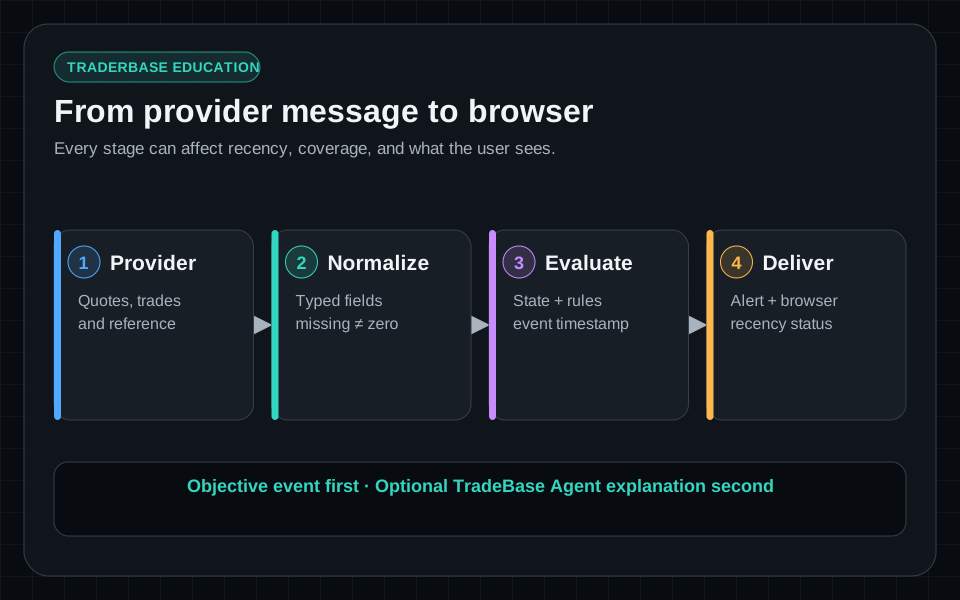
The scanner starts with a market-data feed
A real-time stock scanner cannot be more current than its source data. Quotes, trades, aggregates, reference fields, news, and halt information may come from different provider products with different coverage and timing.
Before evaluating a rule, the application normalizes provider messages into consistent fields such as symbol, price, session change, volume, relative volume, day high, VWAP, market cap, float, and update time. Missing data should remain missing rather than being invented.
Conditions turn changing data into objective events
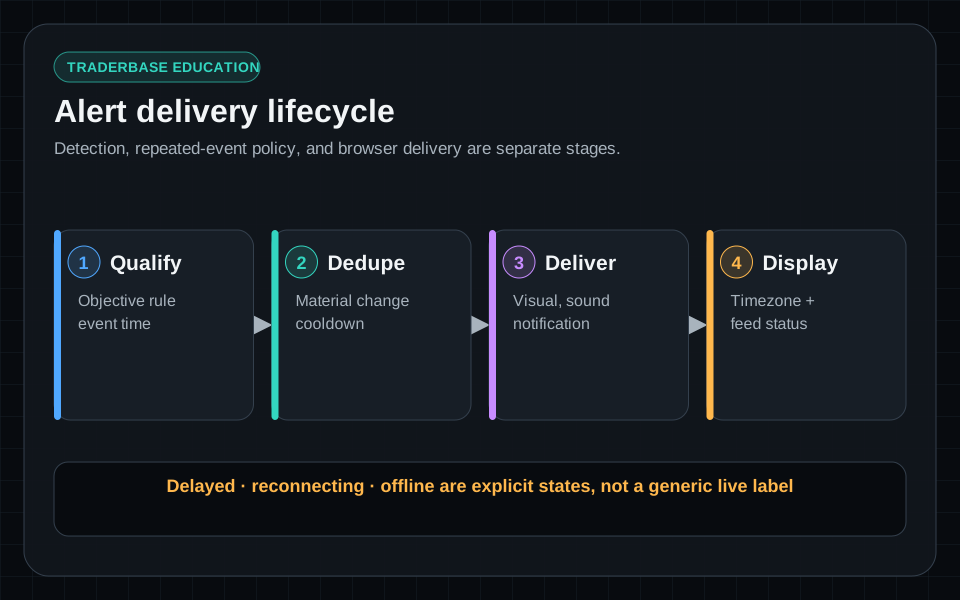
Each implemented scanner compares normalized fields with its configured rules. A high-of-day event might require a current price at or above the tracked session high, while a volume scanner can compare recent volume with a supported baseline and liquidity floor.
State matters. The engine needs to know whether the condition is newly true, still true, or no longer true. Cooldowns and deduplication can reduce repeated noise, but they must not hide a materially new event.
- Normalize provider data without silently estimating unavailable fields.
- Evaluate only supported conditions for the active session.
- Attach the measured trigger and source timestamp.
- Separate event detection from ranking and presentation.
Ranking and streaming solve different problems
A ranked scanner table answers which current candidates best match the configured priorities. A streaming event tape answers what just changed. One symbol may remain near the top of a ranked table while generating several distinct events over time.
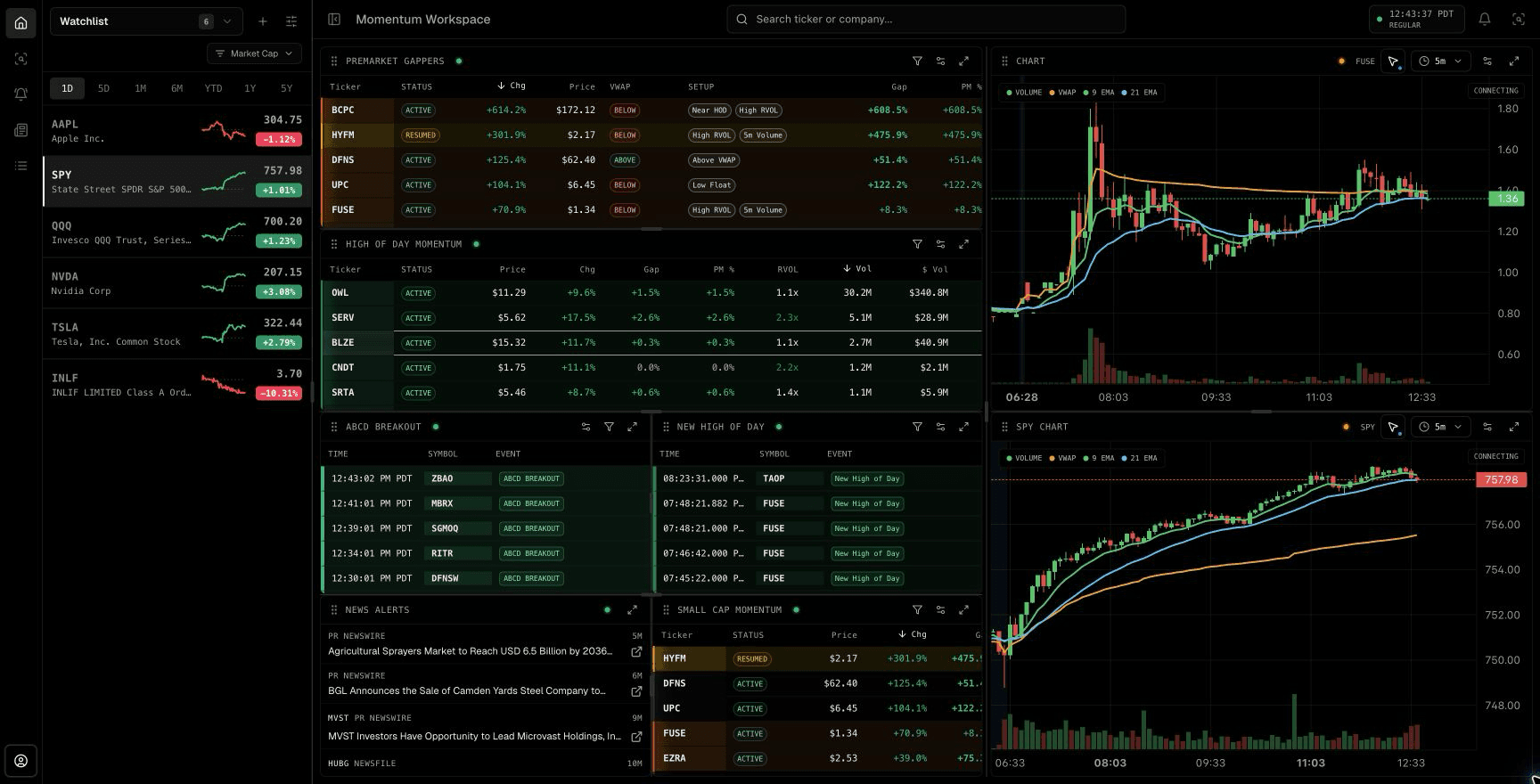
TraderBase keeps those models separate so a trader can compare a compact ranked list while receiving timestamped alerts for supported events. Use Status and Updated on ranked rows; use Time, Event, Hit #, and Since prev on alert rows. Selecting either result carries the symbol into linked chart and market context.
Real time still has measurable limits
Real time does not mean instantaneous or guaranteed. Provider processing, network transit, application queues, browser state, permissions, and reconnects can add delay or create gaps. A responsible scanner exposes connection state, event time, last update, and known delay instead of showing an unconditional live label.
TraderBase Free data is delayed by 15 minutes. Gold includes real-time market data.
Generated explanations organize evidence after detection
Raw price, volume, VWAP, and trigger calculations should remain deterministic and traceable. TradeBase Agent consumes structured scanner evidence after those events exist, connects related changes, and can explain what changed without altering the underlying event.
Open the Agent sidebar beside the current module and confirm its context chip before asking. Agent Brief can organize the current session, repeated symbols, signal types, alert counts, and unavailable sources. A focused question can compare selected rows by RVOL, dollar volume, range position, catalyst availability, and freshness without asking a language model to invent market prices.
Educational content only. Trading involves substantial risk, and scanner events are not recommendations to buy or sell securities.
Common questions
Questions about this scanner workflow
Does real-time market data mean zero latency?
No. Every delivery path has latency, and reconnects or provider issues can cause gaps. The useful question is whether timing and connection health are measured and shown accurately.
Why might a scanner result disappear?
A current-state row can disappear when the symbol no longer satisfies the configured conditions, falls outside the result limit, or becomes stale. Event history should remain separate when the plan includes it.
Should TradeBase Agent calculate raw scanner prices?
No. Raw market values and condition evaluation should come from deterministic code over provider data. TradeBase Agent can summarize or explain the structured evidence after the calculation.